

What is the electrical conductivity of Pcb Direct Welding Terminal Block?
Aug 11, 2025
The electrical conductivity of a PCB Direct Welding Terminal Block is a critical parameter that significantly influences its performance in various electrical and electronic applications. As a supplier of PCB Direct Welding Terminal Blocks, understanding this characteristic is essential for providing high - quality products and meeting the diverse needs of our customers.
Understanding Electrical Conductivity
Electrical conductivity, denoted by the symbol σ (sigma), is a measure of a material's ability to conduct an electric current. It is the reciprocal of electrical resistivity (ρ, rho). The SI unit of electrical conductivity is siemens per meter (S/m). For a PCB Direct Welding Terminal Block, good electrical conductivity means that it can efficiently transmit electrical signals or power with minimal loss.
The conductivity of a terminal block depends on several factors, including the material used in its construction, the cross - sectional area of the conductive parts, and the length of the current path.
Materials and Their Conductivity
The choice of materials for PCB Direct Welding Terminal Blocks plays a crucial role in determining their electrical conductivity. Common materials used in the manufacturing of these terminal blocks include copper and brass.
Copper is widely recognized for its excellent electrical conductivity. It has a conductivity of approximately 5.96×10⁷ S/m at 20°C. Copper's high conductivity is due to its atomic structure, which allows electrons to move freely through the material. This property makes copper an ideal choice for applications where low resistance and efficient current flow are required. Many of our PCB Direct Welding Terminal Block products utilize copper for the conductive parts to ensure optimal electrical performance.
Brass, an alloy of copper and zinc, also offers good electrical conductivity. The conductivity of brass varies depending on its composition, but it generally ranges from about 1.5×10⁷ S/m to 2.0×10⁷ S/m. While not as conductive as pure copper, brass has other advantages such as better corrosion resistance and mechanical strength. In some of our terminal block designs, we use brass to balance conductivity with other important properties.
Impact of Cross - Sectional Area and Length
The cross - sectional area of the conductive parts in a PCB Direct Welding Terminal Block has a direct impact on its electrical conductivity. According to Ohm's law and the formula for resistance (R = ρL/A, where R is resistance, ρ is resistivity, L is length, and A is cross - sectional area), a larger cross - sectional area results in lower resistance and higher conductivity.
When designing our terminal blocks, we carefully consider the cross - sectional area of the conductive elements to ensure that they can handle the required current without excessive heating. For example, in our 3.81mm Pitch PCB Terminal Block Connector, we optimize the cross - sectional area of the conductors to provide reliable electrical connections for different current ratings.
The length of the current path also affects conductivity. A longer current path increases resistance and reduces conductivity. Therefore, we strive to minimize the length of the conductive paths in our terminal block designs to improve electrical performance.
Measuring Electrical Conductivity
To ensure the quality and performance of our PCB Direct Welding Terminal Blocks, we use various methods to measure their electrical conductivity. One common method is the four - point probe technique. This method involves passing a known current through the terminal block using two outer probes and measuring the voltage drop across the sample using two inner probes. By applying Ohm's law (V = IR), we can calculate the resistance of the sample and then determine its conductivity.
We also conduct regular quality control tests on our products to verify their conductivity values. These tests help us maintain consistent product quality and ensure that our terminal blocks meet or exceed industry standards.
Applications and Conductivity Requirements
The electrical conductivity requirements of PCB Direct Welding Terminal Blocks vary depending on their applications. In low - power electronic circuits, such as those found in consumer electronics, the conductivity requirements may be relatively low. However, in high - power applications, such as industrial control systems and power distribution units, high conductivity is essential to prevent power losses and overheating.
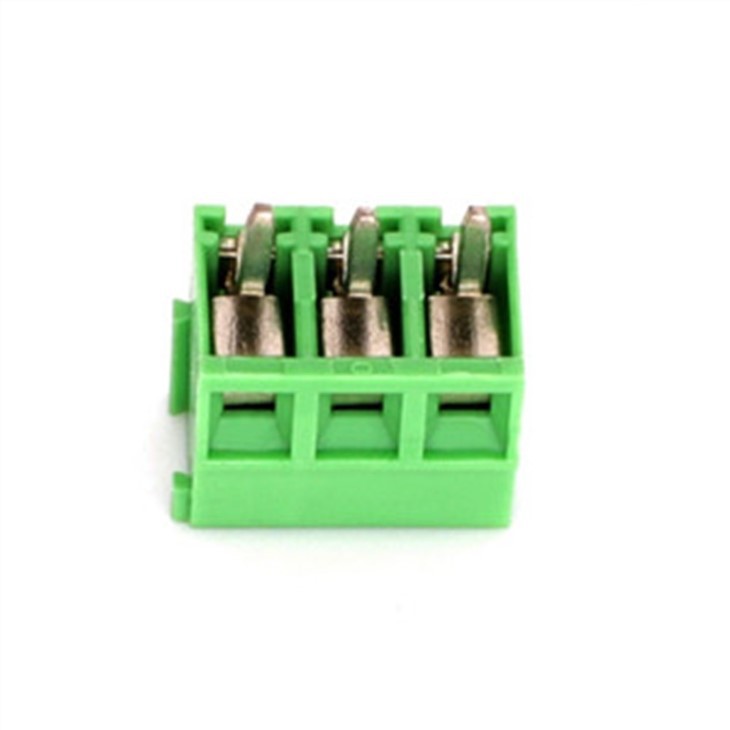

For example, in power distribution applications, our Direct Welding Pluggable Connector for PCB needs to have high conductivity to efficiently transmit large amounts of electrical power. On the other hand, in signal - transmission applications, such as in communication devices, the terminal blocks need to have stable conductivity to ensure accurate signal transfer.
Maintaining Conductivity Over Time
In addition to initial conductivity, it is important to ensure that the electrical conductivity of PCB Direct Welding Terminal Blocks remains stable over time. Factors such as oxidation, corrosion, and mechanical stress can affect the conductivity of the terminal blocks.
To prevent oxidation and corrosion, we use protective coatings on the conductive parts of our terminal blocks. These coatings act as a barrier between the metal and the environment, preventing the formation of oxide layers that can increase resistance. We also design our terminal blocks to withstand mechanical stress, such as vibration and shock, to maintain their electrical integrity.
Conclusion
The electrical conductivity of PCB Direct Welding Terminal Blocks is a fundamental property that determines their performance in various electrical and electronic applications. As a supplier, we are committed to providing high - quality terminal blocks with excellent electrical conductivity. By carefully selecting materials, optimizing the design of the conductive parts, and implementing strict quality control measures, we ensure that our products meet the diverse needs of our customers.
If you are in need of high - quality PCB Direct Welding Terminal Blocks for your projects, we invite you to contact us for further discussion and procurement. Our team of experts is ready to assist you in finding the most suitable solutions for your specific requirements.
References
- "Fundamentals of Electrical Engineering" by Charles K. Alexander and Matthew N. O. Sadiku
- "Materials Science and Engineering: An Introduction" by William D. Callister Jr. and David G. Rethwisch