

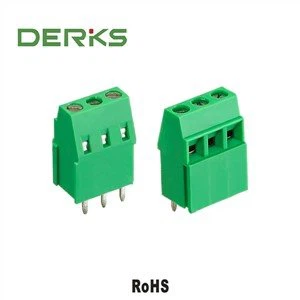
The pluggable PCB terminal block with screw lock are a special form of hybrid terminal blocks. The terminal blocks have a standardized plug-in zone on one side and Push-in, screw, spring-cage or fast-connection technology on the other side. Due to the contact system, they can withstand extreme vibration levels. The plug-in terminal blocks save you a lot of time when carrying out signal and power wiring.
Benefits of Pluggable PCB Terminal Block With Screw Lock
Quick and Simple Wiring
Pluggable PCB terminal block with screw lock allow wires to be securely fastened without soldering or crimping. Wire preparation only requires stripping a short length of insulation. Insert the stripped wire end into the terminal block opening and tighten the screw to clamp down on the conductor.
This straightforward wiring process enables faster assembly and lower production costs than soldering. Wiring errors are also reduced.
Flexible and Adaptable
One of the significant advantages of pluggable PCB terminal block with screw lock is their modular design. Swapping out terminal blocks
Terminal blocks commonly have a standard pitch (distance between terminals), making mixing and matching different blocks straightforward. Spacing options like 3.5mm, 5mm, 7.5mm, 10mm, etc., allow designers flexibility for their layout and wiring density requirements.
Reliable and Vibration Resistant
The metal-to-metal screw clamping mechanism creates a gas-tight connection between the wire conductor and the terminal. This ensures a low resistance and robust connection over thousands of mating cycles. Pluggable PCB terminal block with screw lock maintain integrity in high-vibration environments where solder joints could fail prematurely.
Safer Operation
Unlike soldering, pluggable PCB terminal block with screw lock don't require handling hot tools or exposure to lead fumes. The housing insulation protects against accidental contact with live terminals. These safety advantages make pluggable PCB terminal block with screw lock a good choice for novice hobbyists.
Easy Maintenance and Troubleshooting
Individual wires can be quickly accessed, removed, replaced, or reused without desoldering or damage to the PCB or adjacent wires. This facilitates maintenance, upgrades, troubleshooting, and field repairs. Being able to isolate and swap out a lousy wire saves considerable time compared to soldered connections.
-
![5.08mm 5mm Pitch Contact Connector]()
5.08mm 5mm Pitch Contact Connector
Add to Inquiry -
![PCB Electric Terminal Block]() Add to Inquiry
Add to Inquiry -
![5.00mm Pitch PCB Terminal Block]()
5.00mm Pitch PCB Terminal Block
Add to Inquiry -
![PCB Terminal Block with Screw Holes]()
PCB Terminal Block with Screw Holes
Add to Inquiry -
![Screw Type PCB Terminal Block for Electric]()
Screw Type PCB Terminal Block for Electric
Add to Inquiry



Why Choose us
Quality Assurance
We have obtained UL, CE, ROHS, ISO9001 certificates. Selling well in all cities and provinces around China, or products are also exported to clients in such countries and regions as USA, Germany, France, Italy. We also welcome OEM & ODM orders.
Customer service
The company offers excellent customer service and support, making it easy for customers to resolve any issues they may have with the product.
Rich Experience
Our company has many years of production work experience. The concept of customer-oriented and win-win cooperation makes the company more mature and stronger.
Confirm Electrical Needs
● What is the maximum expected operating voltage? Select a voltage rating at least 25% higher.
● What is the maximum continuous current in each wired circuit? Choose a current rating at least 25% above this.
● Will transient voltage spikes exceed the steady-state voltage? Surge ratings may need to be higher.
● Is wiring primarily for power, signals, or a mix? Power wiring needs heavier gauge wires and higher current pluggable PCB terminal block with screw lock.
Evaluate Wire Size and Material
● What conductor gauge will be used? Pick a pluggable PCB terminal block with screw lock that fits the wire size or allows a gauge size up and down.
● Are wires stranded or solid core? Stranded can require special terminals or ferrules to grab multiple strands.
● Is wiring flexible cable, jacketed cable, or individual wires? Larger diameters may need bigger terminal openings.
● Do shielded cables need to be grounded? Select grounding fork terminals to interface shields.
Determine Mounting Factors
● Does the PCB have plated through holes or only surface pads? Match the terminal style to PCB capabilities.
● What spacing between terminals is needed for wiring access or service loops? The larger wire may need more elbow room.
● Will the wiring exit vertically from the PCB or run horizontally? Vertical terminals save space.
● Are higher-density connections required? Smaller pitch terminals allow compact wiring.
● Is polarization needed to prevent miswiring? Keyed housings only allow correct insertion.
Assess Environmental Conditions
● What is the operating temperature range? Standard pluggable PCB terminal block with screw lock function from -40°C to +105°C.
● Will condensation or liquid splashing occur? Water-resistant housings prevent short circuits.
● Does the application vibrate or shock the PCB? Locking screws prevent loosening.
● Is corrosion from chemicals a concern? Gold plating resists harsh environments.
Review Cost Factors
● What is the overall budget? Better performance costs more.
● What production volume is anticipated? Higher quantities permit lower-cost terminals.
● Can vertical integration reduce supply chain costs? Some terminal vendors offer integrated manufacturing.
● Does the design need customization? Unique pinouts or housings add cost.
Confirm Compliance
● What safety agency certifications are mandatory?
● Do hazardous location approvals apply?
● What environmental regulations must be met? Lead-free materials may be preferable.
Types Of Pluggable PCB Terminal Block With Screw Lock
Rising Cage
Rising cage PCB screw terminals are one of the most popular types. They utilize a spring-loaded cage under the screw head that rises as the screw is tightened. This allows wires to be easily inserted into the open cage. Tightening the screw then forces the cage down to clamp the wire.
Rising cage terminals are affordable, easy to use, and reliable. They accommodate a wide range of wire sizes from 24 AWG to 10 AWG. Current ratings up to 20A per terminal are typical. Voltages up to 600VAC/DC can be handled.
Screw and Clamp
Screw and clamp PCB terminals provide a slim, space-saving footprint. Wires pass through a vertical channel in the housing. A separate horizontal clamp piece has an opening that matches the wire size. Tightening the screw compresses the wire between the clamp and a metal contact in the housing.
These economical terminals work well for smaller gauge wires from 22 AWG to 16 AWG. Ratings are usually 10A at 300VAC/DC or less. Their compact design allows packing many positions into a small PCB area.
Piercing
Piercing screw PCB terminals offer fast installation by eliminating wire stripping. Instead, turning the screw forces pointed metal contacts through the wire insulation to make an electrical connection to the inner conductor.
Piercing terminals accommodate 18 AWG to 24 AWG solid core or stranded wires with thin insulation. The current per terminal is generally 10A or less. These simple terminals provide low-cost wiring in high-volume products like appliances.
Push-In
Push-in screw terminals speed up wiring by eliminating the need to turn screws. Wires are pushed directly into the spring-loaded terminal. The terminal's clamping mechanism secures the wire without tools.
Push-in terminals allow quick connection changes by depressing the spring tab to release wires. They handle light-duty wiring from 12 AWG to 26 AWG if rigidity requirements are met. The current per terminal is typically 10A or less.
Pluggable PCB Terminal Block With Screw Lock
Pluggable PCB terminal block with screw lock add modular convenience for connecting cables or wires to boards. They utilize detachable plugs that hold multiple wire terminations. The plugs mate to a header soldered on the PCB.
This arrangement allows plugs to be installed, removed, or replaced without desoldering. Pluggable terminals easily accommodate wiring modifications or replacements. They work well for signal-level connections under 3A.
Feed-Through
Feed-through screw terminals facilitate joining two separate wires or cables. Wires are inserted from opposite sides of the terminal housing and clamped together with the screw.
Feed-through blocks allow flexibility in tying various circuits together or splitting connections. They have similar electrical specs to the rising clamp and screw and clamp terminals. Feed-through types come in pluggable versions too.
Ground
Ground screw terminals provide a convenient connection point to ground wires and cables safely. The terminal screw clamps the wire to the grounded mounting frame or chassis.
Including dedicated ground terminals on the circuit board simplifies meeting safety requirements. Ground terminals help minimize noise by giving shielded cables a low-impedance path to the chassis ground.

There is no universal standard size for pluggable PCB terminal block with screw lock, as they come in a wide range of sizes and configurations to meet the specific requirements of different applications. The size of a terminal block can depend on factors such as the number of terminals or connections required, the wire gauge and insulation used in the application, and the available space on the printed circuit board.
That being said, some common sizes for pluggable PCB terminal block with screw lock are 5.0mm, 5.08mm, 7.5mm, and 7.62mm pitch. Pitch refers to the distance between the center of each terminal, and these sizes are commonly used in applications such as control systems, power supplies, and telecommunications equipment.
In addition to the pitch, other dimensions of a terminal block such as height, width, and length can also vary depending on the specific model and manufacturer. It is important to choose a terminal block that fits the available space on the PCB and meets the electrical and mechanical requirements of the application.
Pluggable PCB terminal block with screw lock are typically made of insulating materials such as plastics, including nylon, polyamide, and polycarbonate. These materials provide a high degree of mechanical stability, electrical insulation, and resistance to heat and chemicals, making them well-suited for use in a wide range of electronic applications.
In addition, some terminal blocks may have metal components, such as the clamping mechanism or contact points, which are typically made of materials such as brass, copper, or steel. These materials provide good electrical conductivity and durability, ensuring reliable and long-lasting performance of the pluggable PCB terminal block with screw lock.
The choice of materials used in the construction of pluggable PCB terminal block with screw lock will depend on the specific requirements of the application, such as the desired level of electrical insulation, mechanical strength, and resistance to environmental factors such as temperature, moisture, and chemicals.
A pluggable PCB terminal block with screw lock, also known as a connection terminal or terminal connector, is composed of several components, each serving a distinct purpose. The block itself is usually crafted from robust thermoplastic material, capable of enduring demanding environments. It comprises:
Conductive Strip: Typically made of copper, brass, or aluminum. It offers excellent electrical conductivity, acting as the fundamental pathway for electrical current from one end of the block to the other.
Screw Clamps: Each clamp secures a wire within a slot on the terminal block, ensuring a dependable and stable connection.
Clamping Component: This component often incorporates a pressure plate that aids in maintaining consistent contact pressure, even when dealing with varying wire cross-sections or in situations of intense vibration.

Zhejiang Deerkesi Electrical Co.,Ltd was established in 2006, which is a professional manufacturer of terminal blocks integrating R&D, design, production and sales. The company mainly produces PCB terminal blocks, screw terminal blocks, plug-in terminal blocks, and spring-type terminal blocks. Through unremitting efforts, the company has rich experience in manufacturing terminal blocks, complete professional production equipment, strict quality control procedures, perfect sales network, and extensive product application examples.
Asked Questions
We're well-known as one of the leading pluggable PCB terminal block with screw lock suppliers in China. If you're going to buy or wholesale high quality pluggable PCB terminal block with screw lock with competitive price, welcome to get pricelist from our factory. Also, customized service is available.
screw lock terminal block for pcb board, screw lock connector on assembly pcb, connector for printed circuit board assembly